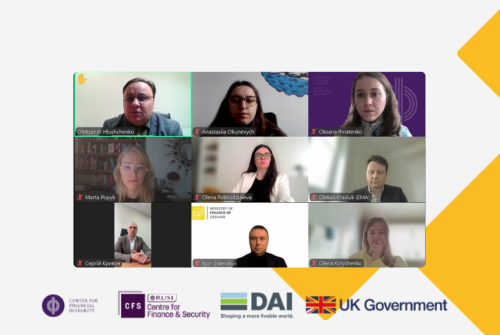
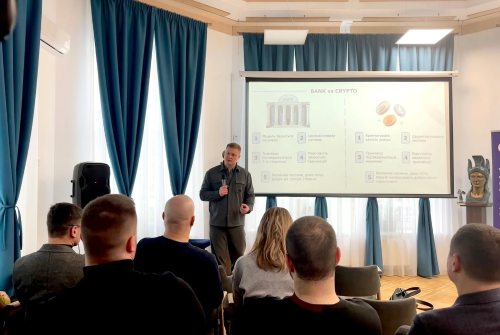
On 12 February, within the framework of the UCIF programme, a training session was organised for financial institutions and designated non-financial businesses and professions (DNFBPs), focusing on the European anti-money laundering framework and its key legislative acts
About the UCIF Project
The Strengthening Ukraine’s Capacity to Counter Illicit Finance (UCIF) aims to lay the foundations for a long-term, systemic reform of Ukraine’s financial ecosystem. The project brings together government institutions, regulators, law enforcement agencies, financial institutions, and international partners to reduce the scale of the shadow economy, increase transparency in the financial sector, and combat money laundering. It is implemented by DAI Global with the support of the UK Foreign, Commonwealth & Development Office (FCDO).
The fifth training session of the project “Strengthening Ukraine’s Capacity to Counter Illicit Finance” (UCIF), held on 12 February, focused on the new EU Anti-Money Laundering Package (EU AML Package). During the event, participants examined its structure, key elements, and potential impact on Ukrainian financial institutions and designated non-financial businesses and professions (DNFBPs).
The growing number of money-laundering-related offences involving European banks prompted the European Commission to reassess the effectiveness of the existing regulatory framework. In response, new, more comprehensive legislation was developed to address regulatory gaps and inconsistencies in the interpretation and application of rules. In 2024, Directive (EU) 2024/1640 (AMLD6) was published in the Official Journal of the European Union, and in July 2025 a new supervisory authority — AMLA (Anti-Money Laundering Authority) — was established.
The updated AML/CFT regime creates a more unified and consistent system for combating money laundering and terrorist financing, comprising several key components.
Key changes to the Anti-Money Laundering Regulation (AMLR) include:
The scope of regulation has been expanded to include targeted financial sanctions (including asset freezing), reflecting closer integration of AML and sanctions policy.
Parent companies are required to ensure the application of internal policies, risk-management procedures, and staff requirements across all branches and subsidiaries — both within the European Union and in third countries (for groups headquartered in the EU).
More detailed and harmonised rules for identifying ultimate beneficial owners have been introduced (ownership threshold — 25% or more).
Customer due diligence (CDD) and enhanced due diligence (EDD) requirements have been strengthened: the range of required data has been expanded, conditions for electronic identification clarified, and requirements regarding the purpose of business relationships specified.
Additional EDD measures have been introduced for high-net-worth clients in cases of personalised asset management of €5 million or more.
The definition of politically exposed persons (PEPs) has been expanded to include siblings of certain PEPs, who are now also subject to enhanced due diligence.
A legal framework for information sharing between public and private sectors under defined conditions has been established.
The implementation of the new EU Anti-Money Laundering Package not only enhances the effectiveness of preventing financial crime but also sets higher compliance standards for financial institutions and DNFBPs.