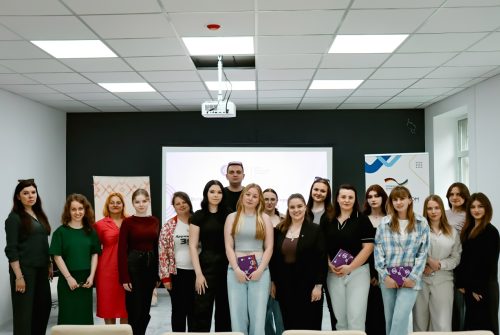
On 13 August, the Centre for Democracy and Rule of Law (CEDEM) held the online school “Financial Monitoring of the Civil Society Sector: Challenges, Realities and European Legislative Requirements”. The programme was designed to strengthen the knowledge and practical skills of representatives of local, regional and national civil society organisations (CSOs) and their coalitions in the areas of financial security, banking services, identification of ultimate beneficial owners, compliance with AML/CFT legislation and relevant European standards.
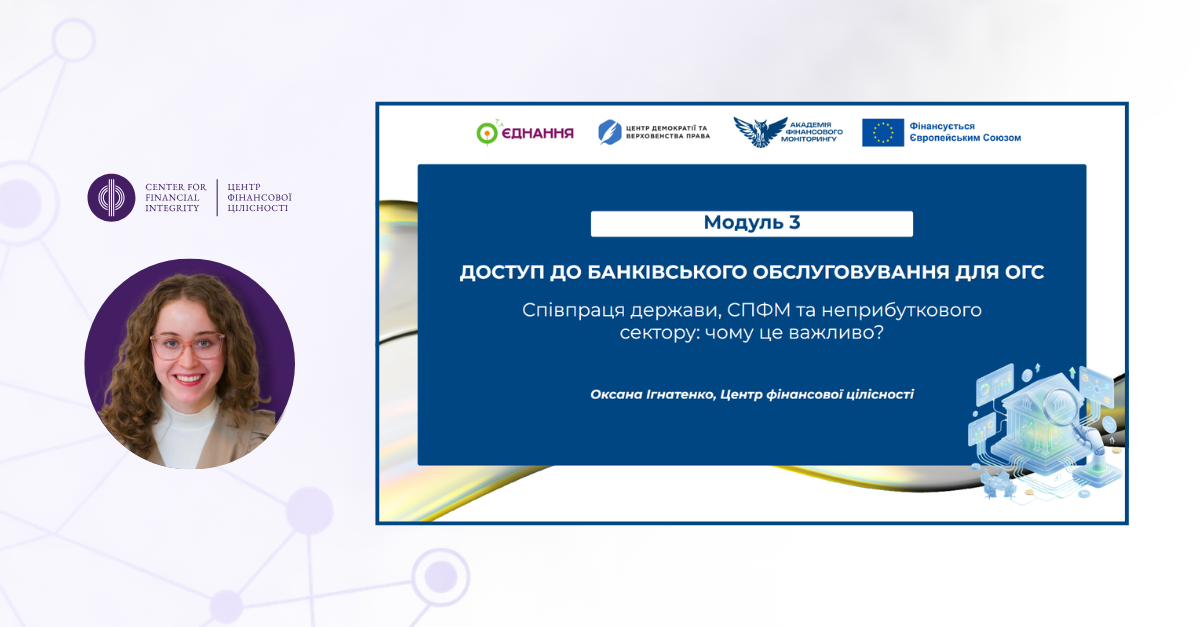
The Center for Financial Integrity joined the school and took part in a discussion on civil society organisations’ access to banking services and the importance of systematic dialogue between the state, primary financial monitoring entities and the non-profit sector.
Against the backdrop of the war, financial and sanctions risks are increasing, while the activities of Ukrainian CSOs — including work in frontline regions, international funding, sub-granting and cross-border payments — may have formal characteristics associated with higher risk. At the same time, a complex or unusual transaction does not necessarily indicate a high level of risk, which is why an individual risk-based approach is essential.
This is in line with FATF Recommendation 8, which calls for targeted, proportionate and risk-based measures for the non-profit sector. For such an approach to work effectively in practice, systematic dialogue between the state, primary financial monitoring entities (PFME) and CSOs is essential to develop a better understanding of actual risks and the specific nature of the sector’s activities. The aim is not to weaken oversight, but to make it more precise, evidence-based and proportionate to the actual level of risk.
We thank the Centre for Democracy and Rule of Law (CEDEM) for the opportunity to contribute to this important discussion and for its work to strengthen dialogue between the state, the financial sector and civil society.